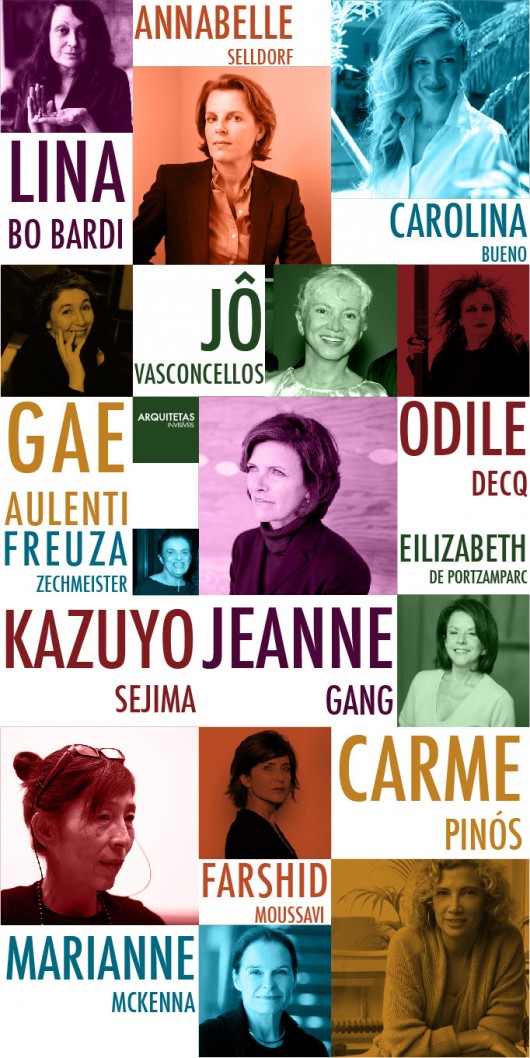
To celebrate International Women’s Day, we asked the Brazilian non-profit group Arquitetas Invisíveis to share with us a part of their work, which identifies women in architecture and urbanism. They kindly shared with us a list of 48 important women architects, divided into seven categories: pioneers, “in the shadows,” architecture, landscape architecture, social architecture, urbanism and sustainable architecture. We will be sharing this list over the course of the week.
Today we present women architects who stand out for the quality of their work.


Architecture
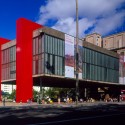
These architects stand out for their quality work. Many designed buildings that today are symbols of a specific time or place. Whether for their aesthetic, functional or technical aspects, these projects are undeniably relevant and draw attention. Kazuyo Sejima, winner of the Pritzker Prize along with Ryue Nishizawa, has designed striking buildings around the world. Like her, Farshid Moussavi, Jeanne Gang, Gae Aulenti, Annabelle Seldorf, Carme Pinós, Carolina Bueno, Jô Vasconcelos, Elizabeth de Portzamparc, Freusa Zechmeister, Marianne Mckenna and Odile Decq are recognized globally and have designed award-winning projects. Although Italian born, Brazilian citizen, Lina Bo Bardi worked mostly in Brazil, she is known for the quality and inventive nature of her designs, and especially for her design of the São Paulo Art Museum (MASP).
* Also See 5 Women Changing the Face of Architecture
ANNABELLE SELLDORF

German architect born in 1962. Her office is certified by New York City and New Jersey as a company run and organized by women.

Spanish architect born in 1954. Among some of her standout projects are the Urban and Bridge Park (1999), in Alicante, Spain; La Serra High School (2001), in Lleida, Spain; the Ses Estacions Park (2002), in Palma, Spain; the Cube Tower (2004), in Guadalajara, Mexico; the Sports Centre (2005), in Egues, Spain; Primary School (2006), in Castelldefels, Spain; and Department 4 at the Vienna University of Economics and Business. She has also won several architecture awards.

CAROLINA BUENO

Brazilian architect born in 1975. Co-founder of the French-Brazilian company Triptygue Arquitetura, she tackles problems facing developing cities, and analyzes the evolution of urban spaces and modern construction.


French-Brazilian architect born in 1955. She has written diverse publications on urbanism and urban planning. Some of her most notable projects include the Musée de la Romanité in Nimes and the new city center in Massy, France.


Iranian architect born in 1965. She is currently a professor at Harvard, and has also taught at the Academy of Fine Arts in Vienna, Princeton and the University of California in Los Angeles (UCLA). She has written two books on design practice and was one of the co-founders of Foreign Office Architects (FOA) in London.


FREUSA ZECHMEISTER
Brazilian architecture who graduated from the Federal University of Rio de Janeiro in 1964. She works on architecture, interior, design and landscape projects and has also worked as a costume and set designer for the dance company Grupo Corpo since 1981. With boldness and irreverence she uses a mixture of colors, materials, and styles that are very Brazilian.


Italian architect born in 1927. She worked as a stylist, architect and interior decorator and taught in the US, Canada, Spain and Germany. She received the Special Prize for Culture from the Italian government in 1989 and the Praemium Imperiale award for architecture, awarded by the Japan Arts Association in 1991. She was president of the Brera Fine Arts Academy in Italy from 1995-96. On October 16, 2012 she made her last public appearance during the award ceremony at the Milan Triennale, where she received the last award of her career. She died in 2012 at the age of 85.


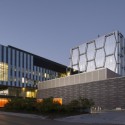
North American architect born in 1964. She was the first woman to design a skyscraper, the Aqua Tower in Chicago. Other notable projects include the Nature Boardwalk, Columbia College Chicago’s Media Production Center, the SOS Lavezzorio Community Center and the WMS Boathouse.

Brazilian contemporary architect, she was the co-creator of two magazines in the 70s. She founded the Jô Vasconcellos & Arquitetos Associados office and later the Maia Arquitetos Associados office that she, along with Éolo Maia, ran together as a team for more than 20 years, participating in numerous competitions.


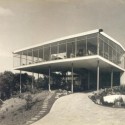
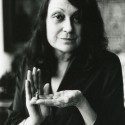
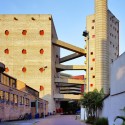
Italian-Brazilian architect born in 1914. She was a professor, writer, graphic designer, magazine editor, set designer, costume designer and exhibition curator. Along with Pietro Maria Bardi, she created and directed the Industrial Design course at the Institute of Contemporary Art (IAC), where she taught Jacob Ruchti, Lasar Segall, Eduardo Kneese de Melo, Roberto Burle Marx, Oswaldo Bratke, Rino Levi, Giancarlo Palanti, Elizabeth Nobling, Alcides da Rocha Miranda, Thomas Farkas, Rudolf Klein and Clara Hartoch. She designed numerous buildings in Brazil including the São Paulo Museum of Art (MASP); Glass House (her home in São Paulo) and the Sesc Pompéia cultural center. She died in 1992 at the age of 78.


Canadian architect born in 1951. In 2010 she was named one of Canada’s Top 100 Most Powerful Women. She gave a series of lectures at McGill University, L’Université de Montréal and Toronto University. She received international attention for her design of the Jackson-Triggs winery in Niagara state, Canada. This project became a model for sustainable design and she was chosen to represent Canada in the Sustainable Building Challenge that was held in Norway in 2002. According to McKenna, she is most proud of her restoration of the Royal Conservatory of Music, which she worked on for 18 years.


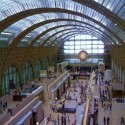
French architect born in 1955. She was a professor at the École d’architecture in Grenoble, the École spéciale d’architecture in Paris, the Vienna Technical University, the Bartlett School of Architecture in London, the Kunstakademie in Vienna, the Kunstakademie in Dusseldorf and the head of the Ecole Spéciale d’Architecture in Paris. Among her most notable projects are the Museum for Contemporary Art and the interior of the Phantom Opera Garnier restaurant, both in France.


KAZUYO SEJIMA 妹島 和世

Japanese architect born in 1956. She was awarded the Pritzker Prize in 2010 along with Ryue Nishizawa. Together the two founded SANAA. Among their main projects are the New Art Museum in New York, the Louvre-Lens in France and the Shibaura House in Japan.


Stay tuned for the rest of the 48 Women in Architecture and check out parts 1 and 2, here.








Arquitetas Invisíveis Presents 48 Women in Architecture: Part 3, Architecture originally appeared on ArchDaily, the most visited architecture website on 11 Mar 2015.
send to Twitter | Share on Facebook | What do you think about this?
Source:: http://feedproxy.google.com/~r/ArchDaily/~3/BCl6GcjrCcQ/