
- Architects: Hordor Design Group, Atelier Alter
- Location: Qujing, Yunnan, China
- Architect In Charge: Yan Huang
- Area: 202361.0 ft2
- Project Year: 2015
- Photographs: Courtesy of Atelier Alter


- Design Architect: Yingfan Zhang, Xiaojun Bu
- Project Architect: Qiuda Lin, Weining Lin
- Architecture Design Team: Zhanghan Zheng, Zhenqing Que, Ling Zeng, Jeff Ding
- Structure: Masha Yang, Yingying Lin
- Mep Engineer: Guangyu Zhang, Xiaonan Zhu, Xiaoan Han
- General Contractor: Fourth Construction Co.,LTD of Yunnan Architectural Engineering Group

From the architect. Qujing is one of a kind. Two impossible miracles co-exist in city of Qujing: the Longyan Tablet and a fish fossil of 4,000-billion-year-old. While Longyan Tablet marks the invention of a prominent calligraphic style, the fish fossil rewrites geology in human history.

The archaeological relics are both metaphor and subject matter of the project. According to Plato, “whatever once exists can never cease to exist,” the collective consciousness of the city and her citizens awaits a resurrection, in a contemporary setting, through the materialization of a series of significant projects.

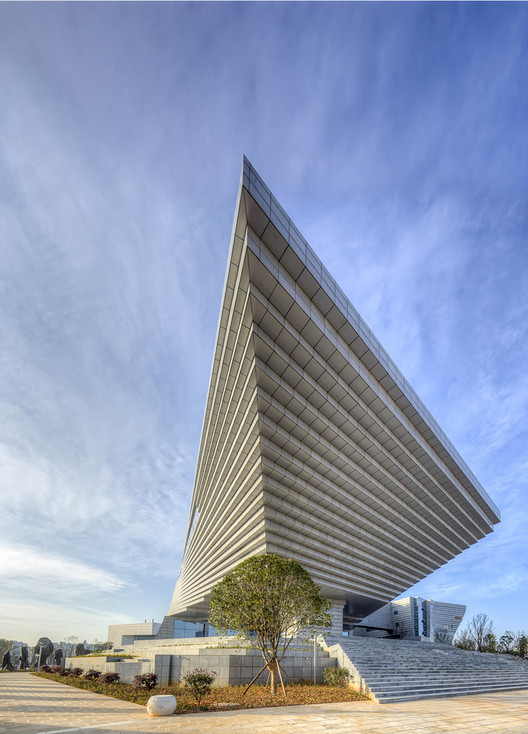
The museum is entered through center of building mass. Audiences are elevated to a concrete plateau, as they begin their exhibition routes at a strategic point in space. A vertical plaza is defined by processional steps and its echoing suspended roof. The graduate suspension of the enormous roof presents an “anti-gravity” architecture statement that puts the audiences in awe.

One could experience the immensity of space and time the city occupies. The strong presence of the void reinstates the gravitas of the museum’s subject matter: a profound history dates back over 4,000 billion years.

A vertical landscape made of concrete drapes down from roof to the ground. As audiences penetrate the landscape and reach to the exhibition zone, geography and humanity converge at that every moment.

Instead of assimilating into analogies of the site—terrace field, fossil grain, or calligraphic strokes—the formal expression of the architecture is in dialogue between the concrete and the abstract, the familiar and the unfamiliar.