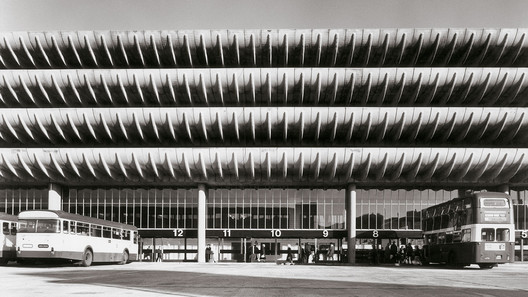

In 2013, following a number of campaigns, a 1969 Brutalist icon in the northern British city of Preston was listed. The future of this bus terminal—one of the largest in the UK and the biggest in Europe when it originally opened—was, until last month, a matter of considerable speculation and debate. This week the results of an international open-call competition for proposals transforming into a new youth centre were revealed, selecting the proposal of New York based practice John Puttick Associates as ‘the best of the lot.’ The ‘lot’, however, left something to be desired.

Preston Bus Station was designed by Manchester-based Building Design Partnership (BDP) during their heyday, and at a time when Preston was a major stop on the M6, Britain’s first motorway. As nothing more than a sheltered public transport terminal below with four tiers of multi-storey car park above, it was not destined to be anything more than an eighty-gate bus station. Soon, however, its 190 metre-long ridged parapets, which extend the whole length of the building, became synonymous with a stylistic variant of Brutalism that was far more sinuous and sculptural than other buildings of the same era. Engineered by Ove Arup, the final interior details were implemented by BDP’s in-house graphics team who chose to narrate the internal public spaces with airport style signage.

Although the building looked and functioned better than many members of the public could have imagined, it soon faced wider problems. The bus station’s scale had been determined by a population boom predicted for the 1960s — an explosion which did not materialise to the extent that those in government had anticipated. Preston, which had been earmarked as a major new city in the wider ‘suburb’ (the Central Lancashire New Town) of the metropolitan areas of Manchester and Liverpool, was therefore never required to deal with the anticipated population over-spill. As a result, the bus station became a white elephant: a supersized transport terminal in a city which could have comfortably operated with a station half of its size.
During the building’s darkest days, when the threat of demolition loomed tall, Richard Rogers publicly declared in a letter to Preston City Council that the bus station was, and is, “an outstanding piece of twentieth century architecture.” The campaign to protect it ramped up and, once its future had been secured thanks in part to the Minister of Architecture and Heritage’s (Ed Vaizey) foresight to protect a collection of similar post-war structures, the next phase in the building’s life had to be decided upon. Preston City Council, who had stated from the outset that they believed refurbishment and renovation to be unnecessarily costly, had been backed into a corner by a top-down decision from Westminster.
Together with the Royal Institute of British Architects (RIBA), an open international ideas competition was launched in February 2015. With £13 million (around $20 million) set aside for the project, the brief challenged participants to think of a way of housing a new youth centre in and around the bus station while preserving the building’s iconic aesthetic charm. The proposed programme required an indoor sports hall, outdoor sports pitches, a climbing wall and a fitness suite to be incorporated alongside other spaces for music, dance, and arts and crafts.
Five proposals were revealed in the following July — each, on the surface, more contextually inappropriate than the last. They were put to a public ballot in which over 4200 people voted, the results of which “were taken into account by the judges when making their final decision.” Entrants included Flanagan Lawrence, Letts Wheeler Architects, Sane Architecture, and Cassidy + Ashton, from which John Puttick Associates emerged triumphant. The ten-strong jury, comprised of members of Lancashire County Council and representatives from the community, youth services and a city council member, had two architects on board: Hugh Broughton, RIBA Adviser, and an anonymous “technical officer”.
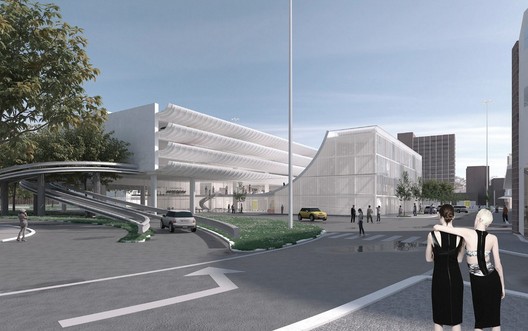
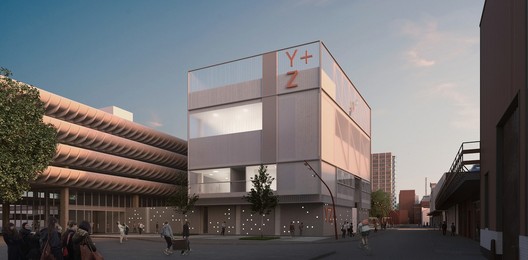
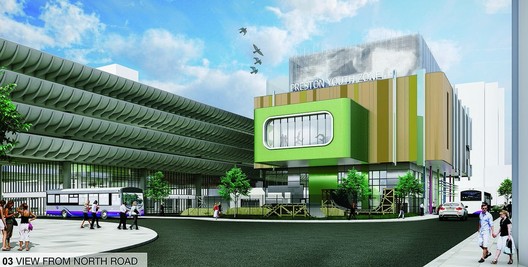
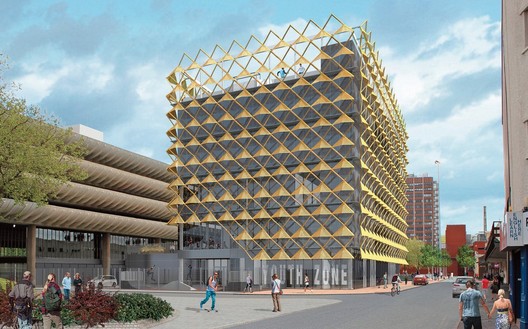
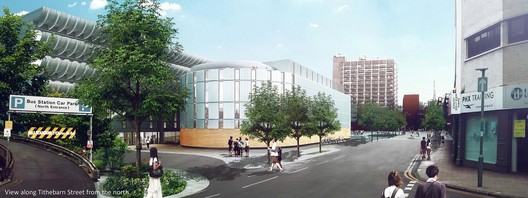
Some have cited the narrow scope of the brief or the proposed budget to blame for this discouraging rostra of proposals, and others—myself included—cannot fathom as to why the sub-standard schemes were in such wild opposition to the bus station proper. The story is much the same in each: the proposals either appear ignore their adjacent context or, for those that do attempt to engage, do so insensitively.
John Puttick’s winning scheme, perhaps chosen as the best of a disappointing lot, undoubtedly feels like a missed opportunity. These frustrations are shared by Eddy Rhead of the Manchester Modernist Society who, speaking to The Guardian, suggested that the design “looks like the compromised result of design-by-committee.” It inconsiderately bulges out from the existing building, clad in a material which feels visually at odds with the curved concrete surfaces of the bus station. Where the two entities meet, the cladding extends into the (presently) glazed plinth of the station. Put simply, it feels ill at ease with its adjoined neighbour.

Seriously, is this lumpen thing the best of 100 entries for the Preston Bus Station competition? http://t.co/93mkyx1g2q
— Hugh Pearman (@hughpearman) August 17, 2015
‘56000’ – a filmic love letter to Preston Bus Station about to be traduced by dull American competition winner. https://t.co/DBXDrqVYIl
— Catherine Slessor (@cath_slessor) August 17, 2015
‘This design is total rubbish’: Preston’s majestic bus station’s insulting makeover http://t.co/9bEQOoC2xY pic.twitter.com/DmNYZeX6DQ
— The Guardian (@guardian) August 18, 2015
Support from members of the public, architects and campaigning parties have provided Preston Bus Station with the possibility of a future which does not compromise its architectural integrity. The results of this competition have not provided a thoughtful, appropriate architectural response to the challenge at hand; the city of Preston deserves a great deal more than what they have been offered. It is anticipated that Presto County Council will seek to retain the services of the winning consultant at least up to and including RIBA Stage 4 (technical design) and “probably beyond to the completion of the project.”
Following the announcement of the results, ArchDaily received this unsuccessful proposal from Milan-based practice Piuerre. We would like to feature any other high quality proposals for the regeneration of Preston Bus Station that were also not shortlisted: please submit your scheme to us here.


From the architect. The building, conceived as a slab, physically flows into the existing building and its roof recalls the curved motif of the parking parapets. The maximum height of the new building is lower than the double height ground floor of the bus station, helping to reduce the visual impact of the new building and preserving the curved concrete front of the car park decks.

Bus Station Refurbishment
The western concourse, freed up from its original function, houses a main entrance hall, new commercial facilities, a small open exhibition area, and the new waiting area for coach passengers at the south end. Conceived as one-storey boxes, built out of iroko wood and glass, the new shops do not interfere with the transparency of the façade treatment and the continuous views along the length of the building. The iroko doors, which do not meet current operational requirements, are replaced by burnished metal, maintaining the same proportions and original layout. The curtain wall above the doors is retained. The internal finishes are preserved and all inconsistent materials and signage is removed. On the eastern side the original seating and barriers are preserved and retained in appropriate locations; at the northern and southern end are two new heated and glazed waiting rooms.

Youth Zone Plus
To reduce the visual impact on the bus station, the new Youth Zone building is partially sunken into the ground. The administrative functions and the Plus services are located in the southern wing of the building, and are arranged to guarantee discretion for those attending them. A sunken courtyard and a patio at ground level contribute to bringing light within the building and could be used as external recreation areas. Within the station itself, the layout attempts to preserve an open plan concept as much as possible, and some functions are located in the extended mezzanine floor. The sport facilities are concentrated in the basement. The roof houses the kick pitch and other external recreation areas. The building has a micro-perforated metal sheet skin which, when dark, creates a ‘lantern effect.’