
If there was a most radical decade of the last century, few would come close to topping the 1960s. From the Bay of Pigs to the Beatles, Marilyn Monroe to the moon landing, there was rarely a dull moment. The world of materials was also involved, seeing the invention of a polymer surface of acrylic resin and natural minerals that was easy to clean, scratch resistant, seamless, and hygienic. Better known as Corian, the surface developed by DuPont chemist Donald Slocum in 1967 was a material that met the tough challenges of modern living.

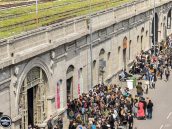
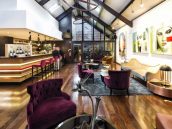
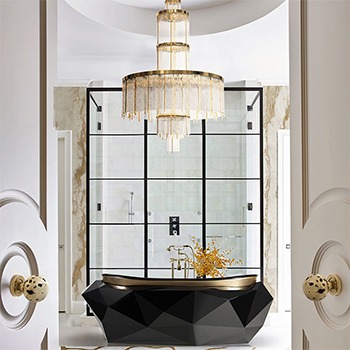
Developed as an alternative to stone and laminate counter surfaces, the product was first available commercially at the National Association of Home Builder’s meeting in Houston, Texas, in 1971. Initially used for kitchen counters, bathroom vanities and molded shower surfaces, Corian‘s applications have expanded to include an almost limitless range, including staircases, furniture, flooring, and jewelry. Recently, both for its durability and ease of cleaning, the product has become a favorite for exterior facades, as demonstrated by the Rue des Poissonniers Housing by MAAST and Atelier King Kong’s Seeko’o Hotel. Corian‘s malleability allows it to be fixed in almost any shape, it is superior to woods and plastics in strength, and is non-porous. Once available only in shades of white, the product is now produced in over a 100 colors, including metallics and a series of heterogenous, stone-like finishes.
The product’s unique characteristics made it an obvious choice for Marc Fornes / THEVERYMANY™, a design studio that engages with Art and Architecture “through the filter of systematic research and development into applied Computer Science and Digital Fabrication.”


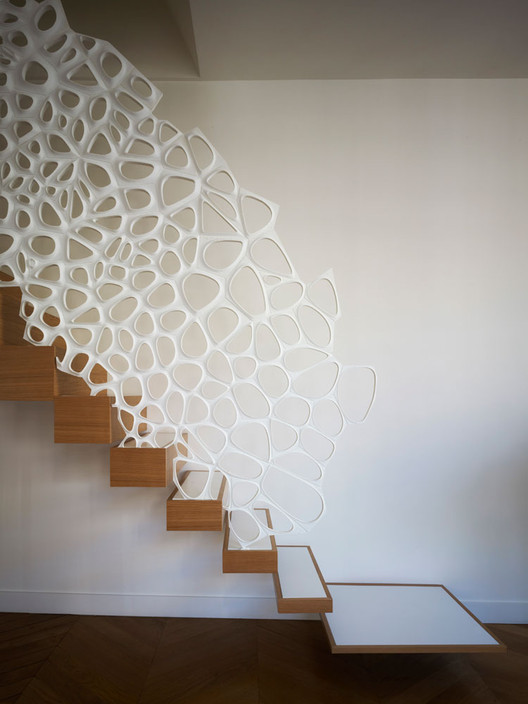
Fashioned by the studio into a biomorphic screen that doubles as a railing in a Paris apartment, Fornes calls working with Corian “straightforward.” In the project, a solid piece of material was robotically milled from both sides to achieve the tight angles of the design. According to Fornes, the project benefited from the fact that Corian is “a forgiving material, which can easily be sanded to eliminate flaws or joints.” However, he adds that “heft” was the biggest challenge of working with Corian, in a project where the design objective was “to create a screen that appears light, maintaining the airiness that characterizes the rest of the apartment.” Ingenuity was required to disguise the weightiness of the material.

For stability, the screen is connected to the wall at the top of the staircase, but “as it descends and becomes two-sided, variation in the thickness, number and size of its cell geometry transform the screen from full and thick to light and porous,” says Fornes. These subtle details are a testament to the strength of the material and the variations made possible by computer-aided milling technologies. The screen’s surface is unfinished, because, Fornes says, “Corian is already soft and sensual to the touch.”