By Eric Oh

The Rail Corridor is transformed into a Linear Forest, adding onto its value as a heritage line that connects from the South to the North of Singapore.. Image Courtesy of Norm Li for MKPL/Turenscape Team
After competing with a strong shortlist of firms, which included OMA, MVRDV, West 8, Grant Associates and Olin Partnership, a team comprising MKPL and Turenscape International has been selected for not just one, but two, of the three projects planned for the Singapore Rail Corridor – the Choa Chu Kang affordable housing development and the Tanjong Pagar Railway Station renovation. Read more about the two projects after the break.
Tanjong Pagar Railway Station Renovation

The reuse of the Tanjong Pagar Railway Station as a community building.. Image Courtesy of Norm Li for MKPL/Turenscape Team
South along the corridor, what used to be the Tanjong Pagar Railway Station will become a multi-purpose community building. Facilities such as a heritage gallery, space for pop-up retail and a public park for community events will be included. The proposal also included an additional entrance and exit for the to-be-built Cantonment MRT station on the Circle, incorporating existing platforms.
“The proposal is sensitive and befitting to the station’s stature as a national monument and icon of our railway history,” said Minister for National Development Lawrence Wong in a speech.
Choa Chu Kang Affordable Housing Development

The waterscape in the precinct is one of its distinct characteristics, where residents are able to get in close proximity with different habitants.. Image Courtesy of Norm Li for MKPL/Turenscape Team
From the architect: North of the Tanjong Pagar Railway station, the Choa Chu Kang is set to become a development of housing units, honoring the heritage of the rail corridor. Its unique identity is safeguarded for ecological continuity by creating a 50 meter wide ‘Forest Reserve Line’. Advocating a ‘light touch’ and an ‘invisible hand’, the project seeks to achieve the delicate balance between natural landscape and landscaped nature. Seeding and planting of trees are phased strategically, to negotiate the balance between the built environment and designed nature, creating opportunities for symbiotic developments. The urban and natural elements of the landscape introduce new systems that will evolve over time, creating interim conditions that are each unique on its own.

Elevated communal decks are shared spaces that are flexible to be programmed to suit the residents’ needs. . Image Courtesy of Norm Li for MKPL/Turenscape Team
A renewed recognition of the emotional, functional and experiential benefits of forest ecology allows a sustainable approach to passive environmental control to transform into a symbolic and literal green spine around which new neighborhoods are constructed. This social connector is complimented by extensive network of pedestrian and cycle path that ensures seamless connectivity between landscaped terrains and its immediate context.

Learning from the natural stratification of the forest structure. Image Courtesy of MKPL Architects
The Pang Sua Canal- an inaccessible 30 meters wide concrete drainage channel that segregated the site from its adjacent neighborhood, is transformed into vibrant, communal spaces where residents are encouraged to relax and engage the water along the flood plains. Residential towers linked by communal decks are elevated above an attractive waterfront space, surrounded by lush greenery.

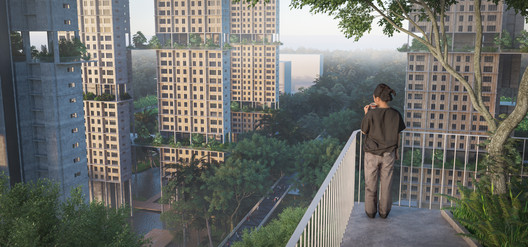
A communal deck stretches into the Linear Forest- the Rail Corridor that has been reforested, where the residents enjoys the rare privilege of living in a forest. . Image Courtesy of Norm Li for MKPL/Turenscape Team
“The awarded proposal for Choa Chu Kang features a very strong and sensitive concept where the housing blocks are positioned to engage with the varying heights of ‘forest greens’ that follow the ascent of the building heights. It is a daring scheme that allows residents at all blocks and levels to enjoy the linear forest, with sky bridges for those on the higher floors and communal farming decks for the lower floors. The integration of Pang Sua Canal as part of the public realm also complements the mid to high rise ‘forest neighborhoods’ to create an extremely pleasant environment,” said one of the evaluation panel member, Raymond Woo, in a press release.

Modular structural logic . Image Courtesy of MKPL Architects
Each housing block adopts a modular structural grid, to optimize buildability. The structural cores and structural columns and beams are standardized. The ‘service modules’, such as the kitchen and toilets for each unit are designed as modular units with opportunity for PPVC (pre-finished, precast volumetric construction) system to be implemented. The different typologies are designed based on the same building module which creates economies of scale and cost efficiency, hence ensuring its affordability while meeting different family and community needs.
The proposal is currently on display at the Singapore URA Centre Atrium from November 9 to November 28, 2015. MKPL Architects will continue to work with URA to refine the concept proposals, also responding to the public feedback received.
- Architects: MKPL Architects, Turenscape International
- Location: Rail Corridor, Singapore
- Consultants: Purcell Asia Pacific Ltd, Culture and Development Consultancy Ltd, KTP Consultants Pte Ltd, DHI Water & Environment (S) Pte Ltd, Arborculture Pte Ltd
- Area: 16100.0 sqm
- Project Year: 2015
- Photographs: Courtesy of Norm Li for MKPL/Turenscape Team, Courtesy of MKPL Architects
News via Urban Redevelopment Authority.