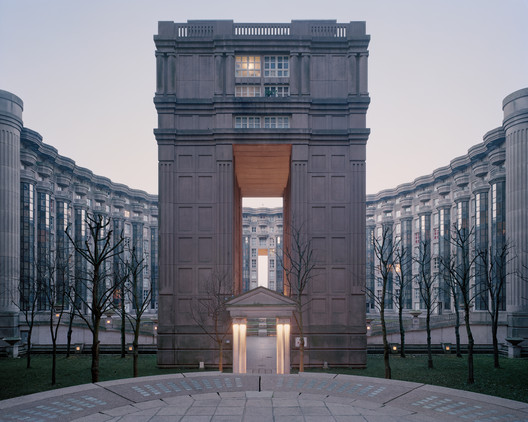
.jpg?1443600100 "Les Espaces d'Abraxas, Noisy-le-Grand, 2014. Image © Laurent Kronental")
East of Paris, in Seine-Saint-Denis, sits a “Babel-like” housing estate. Its otherworldly atmosphere—existing somewhere between a ‘new world’ utopian dream and a postmodern, neoclassical housing estate—has set the scene for a number of Hollywood films including Brazil (1984) and, more recently, The Hunger Games: Mockingjay (2014). Parisian photographer Laurent Kronental’s photo series, Souvenir d’un Futur (Memory of a Future), is an homage to what he describes as the “stranded senior citizens” of the French capital’s Grand Ensemble region. His photographs capture a place and its people which, in spite of its megalomaniacal architectural setting, has been comparatively overlooked.
See Laurent Kronental’s photo series—the result of four years of visits—after the break.
.jpg?1443599941 "Les Orgues de Flandre, 19e arrondissement Paris, 2014. Image © Laurent Kronental")
.jpg?1443599908 "Le Pavé Neuf, Noisy-le-Grand, 2015. Image © Laurent Kronental")
.jpg?1443599809 "Joseph, 88 ans, Les Espaces d'Abraxas, Noisy-le-Grand, 2014. Image © Laurent Kronental")
.jpg?1443599826 "Les Tours Aillaud, Cité Pablo Picasso, Nanterre, 2014. Image © Laurent Kronental")
.jpg?1443600006 "Denise, 81 ans, Cité du Parc et cité Maurice-Thorez, Ivry-sur-Seine, 2015. Image © Laurent Kronental")
The Espaces Abraxas and Arènes de Picasso in Noisy-le-Grand were designed by Ricardo Bofill (Theatre, Arc and Palacio) and Manuel Nunez-Yanowsky (‘The Pie’); both were co-founders of the Taller de Arquitectura. Vast post-war housing estates of this kind were originally built to house a migrant population of rural and foreign refugees and are today—as is often the preconception of the French banlieue—portrayed in the media as dangerous, isolated enclaves which speak of “insecurity and neglect.” Bofill’s postmodern edifices, constructed between 1978 and 1983, were designed to represent an alternative approach to the modernist estates. In Paris in particular, they sought to directly oppose Le Corbusier’s whitewashed visions of the 1950s, which they deemed to be devoid of ‘style’.
In an interview in 2014, conducted by Elvire Camus of Le Monde, Bofill stated that [paraphrased from French] the general idea behind the Theatre, the Arc, and the Palacio was to build three ‘rooms’ of a theatrical space. In retrospect, he acknowledges that the complex has suffered from a lack of community spirit (a typical criticism in the banlieue), emphasised by the closed nature of the developments.
.jpg?1443599841 "José, 89 ans, Les Damiers, Courbevoie, 2012. Image © Laurent Kronental")
.jpg?1443600063 "Paulette, 83 ans, Les Damiers, Courbevoie, 2015. Image © Laurent Kronental")
Indeed, for Wael Sghaier, the exterior of the neoclassical, postmodern Palacio resembles a fortress, barracks, an imperial city, or a prison. Inside, however, all is quiet: time stops and people are scarce [vu de l’extérieur, Le Palacio d’Abraxas ressemble une forteresse, une caserne, une cité impériale ou une prison].
Beyond its dehumanising blandness, its decaying concrete truthfully records the passage of time. In its oversized solitude, this utopian décor reveals itself as a place to live. —Laurent Kronental
.jpg?1443599973 "Les Tours Aillaud, Cité Pablo Picasso, Nanterre, 2014. Image © Laurent Kronental")
.jpg?1443600022 "Les Tours Aillaud, Cité Pablo Picasso, Nanterre, 2013. Image © Laurent Kronental")
.jpg?1443599854 "Josette, 90 ans, Vision 80, Esplanade de La Défense, 2013. Image © Laurent Kronental")
.jpg?1443599991 "Jean, 89 ans, Puteaux-La Défense, 2011. Image © Laurent Kronental")
.jpg?1443600035 "Denise, 81 ans, Cité Spinoza, Ivry-sur-Seine, 2015. Image © Laurent Kronental")
.jpg?1443599926 "Jean-Claude, 82 ans, Les Espaces d'Abraxas, Noisy-le-Grand, 2014. Image © Laurent Kronental")
.jpg?1443599957 "Cité Curial-Cambrai, 19e arrondissement Paris, 2015. Image © Laurent Kronental")
.jpg?1443599868 "José, 89 ans, Puteaux-La Défense, 2012. Image © Laurent Kronental")
.jpg?1443599881 "Joseph, 88 ans, Les Espaces d'Abraxas, Noisy-le-Grand, 2014. Image © Laurent Kronental")
.jpg?1443600048 "Lucien, 84 ans, Les Espaces d'Abraxas, Noisy-le-Grand, 2014. Image © Laurent Kronental")
.jpg?1443599895 "Alain, 80 ans, Les Damiers, Courbevoie, 2013. Image © Laurent Kronental")
.jpg?1443599809 "Joseph, 88 ans, Les Espaces d'Abraxas, Noisy-le-Grand, 2014. Image © Laurent Kronental")
.jpg?1443599941 "Les Orgues de Flandre, 19e arrondissement Paris, 2014. Image © Laurent Kronental")
.jpg?1443599908 "Le Pavé Neuf, Noisy-le-Grand, 2015. Image © Laurent Kronental")
In 2006, Noisy-le-Grand sought to demolish parts of the development. After being met by widespread resentment from the population of Espaces Abraxas, the decision was made to keep them standing — for now. Kronental’s photographs demonstrate very clearly that in spite of any assumed architectural or urban failings, these houses have been appropriated by their residents. In spite of the wider emptiness, houses have become homes.
.jpg?1443599826 "Les Tours Aillaud, Cité Pablo Picasso, Nanterre, 2014. Image © Laurent Kronental")
.jpg?1443600080 "Jacques, 82 ans, Le Viaduc et les Arcades du Lac, Montigny-le-Bretonneux, 2015. Image © Laurent Kronental")
These ‘monuments’, living memories of their time, personify the fragile strength of a youth having blindly aged. —Laurent Kronental
References: francealumni.fr, Ricardo Bofill, Tourisme93, Le Monde
Futher reading: Le Monde: Lost Illusions of an Urban Utopia, Le Parisien, Wikipedia