By Rene Events

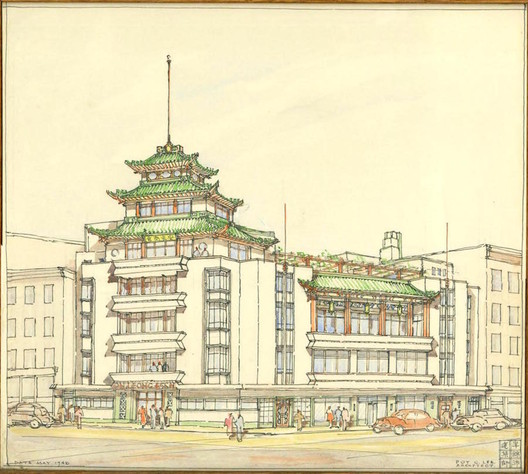
In this survey exhibition, architectural historian Kerri Culhane documents and explores Poy Gum Lee‘s (1900-1968) nearly 50-year long career in both China and New York and examines Lee’s modernist influence in New York Chinatown. This project will result in the first-ever comprehensive list of Lee’s projects in New York. Lee’s hand is visible in the major civic architecture of Chinatown post 1945, which blends stylistically Chinese details with modern technologies and materials. Lee was the architectural consultant for the Chinese Consolidated Benevolent Association’s building on Mott Street (1959) and the On Leong Tong Merchant’s Association at Mott & Canal Street (1948-50) – the most prominent Chinese modern building in Chinatown. Among his highly visible commissions, Lee designed the Chinese-American WWII Monument in Kimlau Square (1962), a modernist take on a traditional Chinese pailou, or ceremonial gate; the Lee Family Association (ca. 1950); and the Pagoda Theatre (1963, demolished).
- Title: Chinese Style: Rediscovering the Architecture of Poy Gum Lee, 1923-1968
- Website: http://www.mocanyc.org/exhibitions/rediscovering_the_hybrid_modernism_of_poy_gum_lee
- Organizers: Museum of Chinese in America
- From: September 24, 2015 06:30 PM
- Until: January 31, 2016 06:00 PM
- Venue: Museum of Chinese in America
- Address: 215 Centre St, New York, NY, 10013