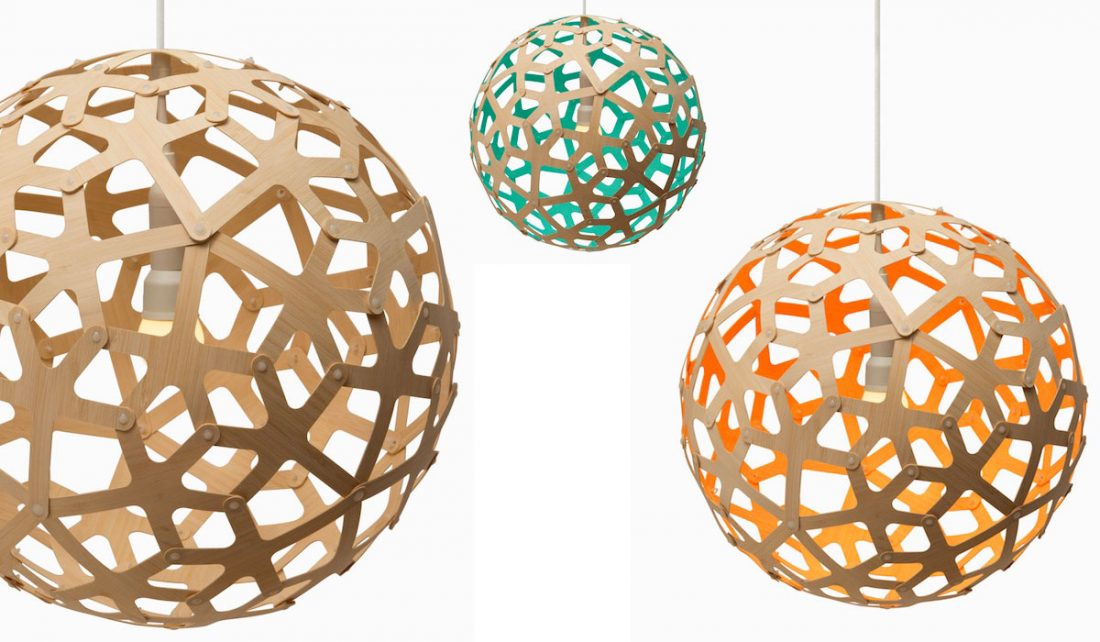

Designer David Trubridge has resolved a dispute with Australian retailer Domayne over replicas of the designer’s most famous modern pendant lamps, Coral and Floral. At issue was whether Domaye was within its rights to produce its own version of the New Zealand-based designer’s original creations, and whether Trubridge had any legal basis for filing a copyright infringement lawsuit. Eleven days ago, the David Trubridge website, while failing to provide details of the agreement, nevertheless stated: “David Trubridge and Domayne are pleased to advise that they have resolved commercially a disagreement regarding the nature of intellectual property rights that may exist in David Trubridge’s Floral and Coral pendant lights.”
Prior to resolving the issue, Trubridge purchased a fake Coral pendant light for the first time, and took to his website to illustrate the stark differences between the genuine article and a knock-off, providing photos of everything from packaging material and integrity of each lighting component to the overall product presentation. The visual differences are clear to even the casual observer, but for Trubridge, more than vanity and ego are at stake. An earnest environmentalist, Trubridge has taken great pains to minimize his products’ carbon footprint, manufacturing each pendant using sustainably sourced local bamboo and creating ‘kitsets’ that ship flat, in the smallest box possible, sans styrofoam and filler. In terms of packing alone, the chasm between the real thing and the fake is palpably clear.

Compact, flat-pack presentation for David Trubridge Coral Pendant Light

Inside packing material for fake David Trubridge Coral Pendant Light
The larger issue goes to the heart of the ‘real vs fake’ design conundrum, which is that independent designers have little control over how to keep even the most blatant knock-offs from entering the market. Trubridge’s designs, though celebrated, admired, and winners of numerous design accolades, are not registered as the real article under current Australian law, and it’s unclear where they would be granted such protection, in light of vague copyright laws which, at best, are prohibitively costly for most designers. Domayne quickly seized upon this sad fact as its defense, but Trubridge countered, ‘They are absolutely within their legal rights to do what they do, but I don’t think a respectable company should do something like that.” No argument here.

David Trubridge Coral Pendant Light components, authentic (left) vs fake.

Close up of top components of David Trubridge Coral Pendant Light, authentic (left), vs fake.
Via David Trubridge