
© Xia Zhi, Wang Quan
- Architects: WANG, CAI & ASSOCIATES
- Location: Huaiyin, Jinan, Shandong, China
- Architect In Charge: Wang Quan, Cai Shanyi
- Design Team: Li Mianli, Xu Hailong, Wang Yimeng, Zhang Changqing, Xu Kun
- Area: 1530.0 sqm
- Project Year: 2014
- Photographs: Xia Zhi, Wang Quan
.jpg?1447005293 "© Xia Zhi, Wang Quan")


- Structural Engineers: Zhang Lijun, Ma Libo
- Mep: Yu Xin, Jing Ling, Meng Wei

© Xia Zhi, Wang Quan
From the architect. Today, most Chinese architecture is defined by two distinct trends: a concern with utility or function or, a focus on image and style. Conversely, our design for the Lanshi Xidi Clubhouse seeks another approach, one that is contemporary and authentic yet tied to its cultural and environmental context. Conceptually, the endeavor is to create a building with a subdued presence that evokes qualities of simplicity and calm, and, is unique and integral to its surroundings.

© Xia Zhi, Wang Quan
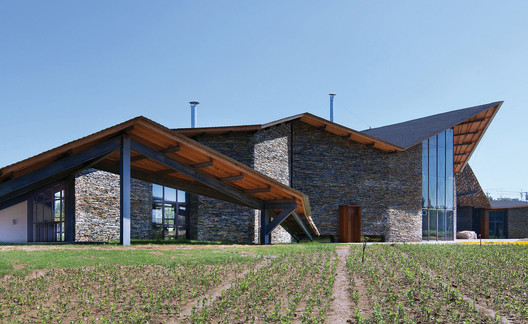
Located in an open farm field, the building is imagined as emerging out of the ground—a building-landscape that responds to its context and translates specific Chinese spatial principles into a contemporary architectural language. Meandering volumes characterize the building organization while an irregular roofline recalls the profile and silhouette of traditional Chinese villages. The primary building volume expands laterally southward emphasizing its connection to the landscape, while a glazed double-height lobby provides a central focus for the community. Instead of a uniform configuration or regular arrangement of spaces, the design translates some the informal attributes of a traditional Chinese village, organizing the program in an irregular manner as well as in accordance with the differences between the public and private nature of the various activities. Circulation is designed to provide a transitional “grey space” between indoors and outdoors and is another example of a traditional spatial principle. Again, the intention is to create a building that is unique to its place and setting by creating a complementary and integral relationship between the building and landscape.

© Xia Zhi, Wang Quan


© Xia Zhi, Wang Quan
The building is oriented to provide natural light and ventilation while thickened walls are used to maximize insulation. The system of construction intentionally avoids mechanization and prefabrication, focusing instead on the process of on-site construction and techniques that celebrate China’s rich tradition of craftsmanship. The major materials are metal panels, strawboard, common red brick and cast concrete. They were selected not only for cost-effectiveness and their capacity to accentuate the qualities of the form and space, but also for their ability to age and weather over time, endowing the building with a sense of growth and life.

© Xia Zhi, Wang Quan