
- Architects: Warren and Mahoney
- Location: Manukau Station Road, Manukau, Auckland 2104, New Zealand
- Project Architect: Mike Jackson
- Area: 20000.0 sqm
- Project Year: 2014
- Photographs: Simon Devitt, Patrick Reynolds


- Project Designer: Blair Johnston
- Builder: Hawkins
- Structural Engineer: Holmes Consulting Group
- Hydraulic Engineer, Mechanical Engineer, Electrical Engineer: Aurecon
- Landscape Consultant: Boffa Miskell
- Interior (Hard Fit Out): Warren and Mahoney
- Loose Furniture: MIT (Hayley-Anne Brown)
- Lighting: Aurecon
- Quantity Surveyor: WT Partnership
- Geotehcnical Consultant, Traffic Consultant: Opus
- Planning Consultant: Beca
- Fire & Safety Consultant: Holmes Fire & Safety
- Acoustics: Marshall Day Acoustics
- Project Manager, Programming Consultant: Beca

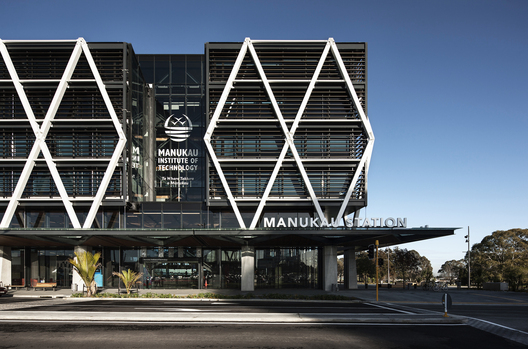
From the architect. MIT Manukau integrates two essential elements: a 20,000m2 learning facility for the Manukau Institute of Technology (MIT) and a new Auckland Transport railway station. By seamlessly weaving together education and transport, MIT Manukau represents a complete departure from conventional education design.

The people of South Auckland enrol in tertiary education at a rate only half the national average. MIT’s mission is to open up the possibility of study in the minds of their community. Correspondingly, MIT Manukau is designed to eliminate barriers to entry and invite people to engage with the possibilities of learning. By integrating the campus with the public transport system, commuters entering the building are exposed to the heart of MIT and its programmes, consequently reaching the widest possible audience.

The ground floor expresses an open invitation to all who approach – a feeling magnified by the soaring six storey atrium. Learning spaces themselves are not formal. Instead, they are flexible, open and designed for student interaction.

Aesthetically, the building has the responsibility to reflect the values and aspirations of MIT while also providing an appropriate response to the community’s cultural diversity. The design response has generated a structurally integrated approach incorporating the direct use of materials, finishes and environmental techniques. The interaction of raking ‘diamond brace’ columns, transverse external steel beam lines, and external horizontal sun shading produces a complex but repeating pattern that is evocative of not one, but many cultures and many points of view.

Internally, the architecture is conceived as a simple framework – a ‘coathanger’ for students to dress with their own identities, to hang the cloak of the community on. It is a very adaptable, open space, incorporating warm timber and vibrant colour; built with long term flexibility to evolve with both the identity of the community and contemporary educational pedagogy.