
- Architects: 51-1 Arquitectos
- Location: Las Casuarinas, Lima, Peru
- Architects In Charge: César Becerra, Fernando Puente Arnao, Manuel de Rivero
- Area: 682.0 sqm
- Project Year: 2012
- Photographs: Cristobal Palma / Estudio Palma
- Project Team: César Becerra, Fernando Puente Arnao and Manuel de Rivero with Edinson Cueva, Sara Gagliarini, David Ávila, Gianfranco Palomino, Mauricio Gilbonio, Militza Carrillo, Eduardo Peláez, Favio Chumpitaz
- General Contractor: Américo Chavez
- Structural Engineers: Salcedo Ingenieros
- Landscape Consultant: Luis Camacho
- Interior/Decoration: Contemporanea, Liz Sosa Design

From the architect. Pachamanca is an ancient Peruvian technique of cooking under the ground with stones and species. It is a spiritual offering of respect to mother earth (in quechua language, pacha means ‘earth’ and manca means ‘pot’)

A couple asked us to design a house for them -professional chefs- and their daughters.

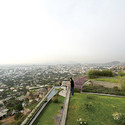
The site is on a terrace of a hill, overlooking the city of Lima and the Pacific Ocean. We were asked by our clients to come up with the most respectful house in the neighborhood and with luxuries being conceptual instead of material.

Lima’s absolute lack of rain (less than 8mm per year!) determines an arid landscape where green appears only when water is brought from 100km away in the Andes mountains.

In Lima, Green is a luxury.
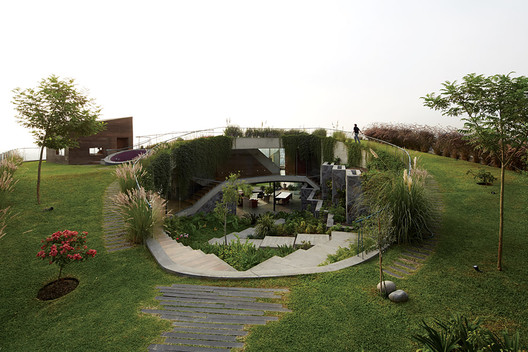
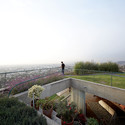
Instead of a building, we decided to start the project by generating an exuberant green landscape. Buildings tend to age and get uglier while vegetation grows and gets better over time.

Manipulating the site we generated a hill, a valley, a plateau, a cliff, a cave, a ravine, a shore…then each corresponded to certain vegetation class while changing altitude: trees, grasses, vegetables, hanging plants, xerophilous, hydrophytes…

Once defined the new landscape, it was inhabited with the house program: dormitories, bathrooms, kitchen, dining, living, home office, garage… carefully pairing the spatial and viewing qualities obtained to their functional requirements.

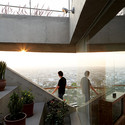
The house –as an exuberant landscape- purposely lacks a hierarchical structure, having multiple entrances, levels and routes, while constantly blurring interior and exterior enabled by the mildness of Lima‘s climate (never colder than 14ºC or warmer than 28ºC).

The house –as an exuberant landscape- purposely shows a rich diversity of finishes and textures: different cuts of local stone, many sorts of recycled wood, concrete imprints, etc.

Baroque and Povera at the same time, like a Pachamanca.

Source:: http://feedproxy.google.com/~r/ArchDaily/~3/P2CaKWhSPWw/pachamanca-house-51-1-arquitectos