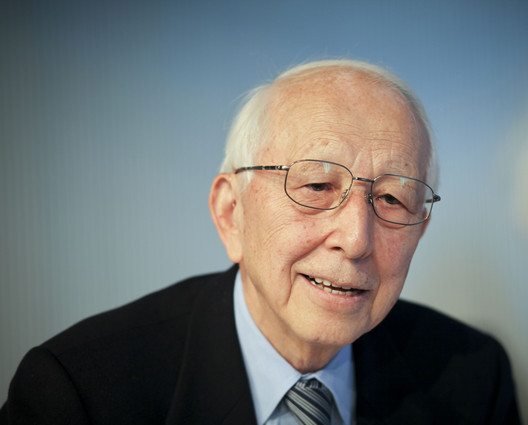

Pritzker Prize laureate and 67th AIA Gold Medalist Fumihiko Maki (born September 6, 1928) is widely considered to be one of Japan’s most distinguished living architects, practicing a unique style of Modernism that reflects his Japanese origin. Toshiko Mori has praised Maki’s ability to create “ineffable atmospheres” using a simple palette of various types of metal, concrete, and glass. His consistent integration and adoption of new methods of construction as part of his design language contribute to his personal quest to create “unforgettable scenes.”


Born in Tokyo in 1928, Maki received his Bachelor of Architecture degree in 1952 from the University of Tokyo, studying under the great Japanese Modernist Kenzo Tange before spending a year at Cranbrook Academy of Art in Bloomfield Hills, Michigan. After completing a Master of Architecture degree at Harvard’s Graduate School of Design (GSD), he apprenticed at the firms Skidmore, Owings and Merrill, and Sert Jackson & Associates. After teaching at Washington University in St. Louis, where he also received his first design commission for the Steinberg Hall (an art center) on that campus, he later joined the faculty at Harvard’s GSD.


In 1960, Maki joined Kisho Kurokawa and Kiyonori Kikutake as part of Japan’s Metabolist movement, though his work in this capacity has been described as more “grounded” compared to the wild utopianism of Kurokawa and Kikutake that is usually connected with the movement. In 1965, he returned to Japan to establish his own firm, Maki and Associates in Tokyo, going on to design high profile projects including the Makuhari Messe (Tokyo), the Spiral (Tokyo), and the Yerba Buena Center for the Arts (San Francisco).

In his essay accompanying Maki’s 1993 Pritzker Prize, architecture historian Kenneth Frampton compares his work to that of Norman Foster, Gunter Benisch and Renzo Piano, adding:
“Needless to say, his syntax has changed across time, from the informal, cubic rationalism of the initial buildings, evidently indebted to [Josep Lluis] Sert, to the tessellated minimalism of the middle period and the layered, light membraceous character of the last.”

In the years since, Maki’s work has largely retained this “light membraceous character” with projects such as the TV Asahi Headquarters in Tokyo, the extension to the MIT Media Lab, and of course the crystalline form of 4 World Trade Center in New York. Forthcoming projects also include China’s first design museum in Shenzhen and his first project in the UK, a nine-story educational space for the Aga Khan Development Network (AKDN).

See our previous coverage of Fumihiko Maki via the links below:
AD Classics: Makuhari Messe / Fumihiko Maki
Fumihiko Maki 2011 AIA Gold Medal Winner
Fumihiko Maki Unveils New United Nations Tower
Fumihiko Maki Commissioned to Design China’s First Design Museum
Maki to Make UK Debut with New Building for Aga Khan Development Network
Source:: http://feedproxy.google.com/~r/ArchDaily/~3/RDbSe1TzFIg/spotlight-fumihiko-maki