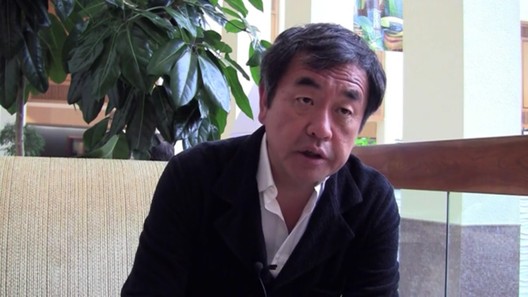

Kengo Kuma (born 8th August, 1956) is one of the most significant Japanese figures in contemporary architecture. His reinterpretation of traditional Japanese architectural elements for the 21st century has involved serious innovation in uses of natural materials, new ways of thinking about light and lightness and architecture that enhances rather than dominates. His buildings don’t attempt to fade into the surroundings through simple gestures, as some current Japanese work does, but instead his architecture attempts to manipulate traditional elements into statement-making architecture that still draws links with the area its built in. These high-tech remixes of traditional elements and influences have proved popular across Japan and beyond, and his recent works have begun expanding out of Japan to China and the West.
.jpg?1438982861 "Green Cast. Image © Kengo Kuma & Associates")
.jpg?1438980816 "GC Prostho Museum Research Center. Image © Daici Ano")

Born in Yokohoma and graduating from the University of Tokyo in 1979, after working locally for a few years Kuma worked as a researcher at Columbia University until 1986. His first practice, Spatial Design Studio, was founded in 1987, followed in 1990 by his current practice, Kengo Kuma & Associates, although he continued teaching at Columbia. His early work tended towards the post-modern, but the bursting of the Japanese bubble and the “Lost Decade” of the 1990s created an environment that was not hospitable to such extravagant architecture. Instead of going abroad like many of his contemporaries, Kuma took the opportunity to find and engage with smaller scale craftsmen that became more prominent during the economic trouble, something he credits with reinvigorating his style, moving his focus from the big picture to repeated use of small elements.

This is also what led to his focus on reinventing natural materials. Traditional Japanese architecture is heavily focused upon rhythm and light, but using natural materials conventionally to achieve this limits your palette heavily. Instead, Kuma began taking materials like stone and using them as though they were light woods or glass, taking thin slices of it and using them as particles. His Stone Museum in Nasu (2000) is a great example of this, taking local stones to create soft and porous walls which shift in the light.


Other high profile buildings include the Nagasaki Prefectural Museum (2005) the Asakusa Culture Tourism Centre (2012) and a commune by the Great Wall of China (2002). In recent years he has also received an increasing number of commissions in Europe, including a Metro Station in Paris, a cultural village in Portland’s Japanese Garden, and Dundee’s new V&A Design Museum. Despite all this, and despite having 150 employees working in his Paris, Tokyo and Beijing studios, Kuma still focuses a lot of his time on small scale commissions, working on private houses and shopfronts, especially after the 2011 Japanese earthquake and tsunami.


See all of Kengo Kuma’s work featured on ArchDaily via the Thumbnails below, and further coverage below that:


.jpg?1438982846 "Starbucks Coffee. Image © Masao Nishikawa")
.jpg?1438982871 "Xinjin Zhi Museum. Image © Kengo Kuma & Associates")

.jpg?1438982525 "Yusuhara Marche. Image © Takumi Ota Photography")
.jpg?1438981979 "Camper Store Milano. Image © Zeno Zotti")
.jpg?1438982322 "Marronier Court. Image © Daici Ano")

.jpg?1438982506 "Shimonoseki-shi Kawatana Onsen Koryu Center. Image © Mitsumasa Fujitsuka")

.jpg?1438982220 "Kanayama Community Center. Image © Takeshi Yamagishi")


.jpg?1438982535 "Shiseikan. Image © Fujita Syashin Kobo")


Seven Architects Transform London’s RA into Multi-Sensory Experience
Video: Asakusa Culture Tourist Information Center / Kengo Kuma
Video: SunnyHills at Minami-Aoyama by Kengo Kuma
Siza, Souto de Moura, Kuma Reflect on Their ‘Sensing Spaces’ Exhibitions
Lecture: After March 11th / Kengo Kuma
Source:: http://feedproxy.google.com/~r/ArchDaily/~3/o0BCnxgmjFo/spotlight-kengo-kuma