By Rory Stott

As one of the leading architects of the British High-Tech movement, Pritzker Prize-winner Richard Rogers stands out as one of the most innovative and distinctive architects of a generation. Rogers made his name in the 70s and 80s, with buildings such as the Centre Georges Pompidou in Paris and the Headquarters for Lloyd’s Bank in London. To this day his work plays with similar motifs, utilizing bright colors and structural elements to create a style that is recognizable, yet also highly adaptable.


Rogers was born in Florence, but his family moved to Britain during the Second World War, when Rogers was a child. After Attending the Architectural Association in London, Rogers studied in the United States at Yale University, where he met fellow Brit Norman Foster. After graduating, the two architects joined forces with Su Brumwell and Wendy Cheeseman to form Team 4 in 1963. Though their collaboration as Team 4 lasted just four years, it would prove to be a crucial formative stage in British architecture, as both Rogers and Foster went on to be the leading names of the British High-Tech scene.

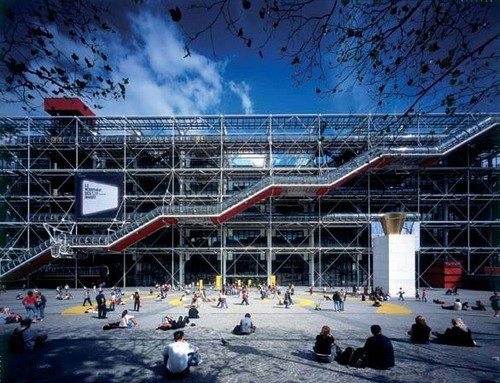
Shortly after Team 4 was disbanded, Rogers began another fruitful collaboration, this time with Renzo Piano. The duo’s big break came in 1971 when, working with architect Gianfranco Franchini and Peter Rice, an engineer from Arup, they won the competition to design the Centre Pompidou. Still young and relatively unknown, Rogers and Piano shocked many with their radical design, placing the building’s services in full view in a trademark Rogers technique that went on to be known as “bowellism.”

Despite a mixed reception when it was completed in 1977, the Centre Pompidou has gone on to be a much-loved building in Paris. It is widely recognized as a defining moment in the history of museum design, as its unpretentious and futuristic design was intended to break down the elitist aura that was often held by art museums. A similar occurrence happened in London a decade later: now working as Richard Rogers Partnership, Rogers utilized his bowellist style again at the Lloyd’s of London Building, garnering criticism at the time. However, the Lloyd’s building is now a treasured landmark of central London, and was even given the UK’s highest listed status, Grade I, in 2011.

In the 1990s Rogers became involved in British politics, sitting in the House of Lords as a Labour Peer (his full title is Baron Rogers of Riverside). This led to an invitation by the government to set up the Urban Task Force, which in 1998 conducted a review into the causes of urban decay and outlined a vision for the future of British Cities in the paper ‘Towards an Urban Renaissance.’ For 8 years he was also chief advisor on architecture and urbanism for the Mayor of London.

In more recent years Rogers has continued to produce work of great merit, winning the Stirling Prize in 2006 and 2009, and the Pritzker Prize in 2007.
See all of Richard Rogers’ work featured on ArchDaily via the thumbnails below, and more coverage of Rogers below that:


Richard Rogers wins Stirling Prize for Maggie’s Centre
Richard Rogers Honoured at New London Awards
Richard Rogers Honored with Lifetime Achievement Medal
Pritzker Prize Appoints Richard Rogers As Newest Jury Member
On Top of the City: Behind the Scenes at the Leadenhall Building
Review: ‘Richard Rogers: Inside Out’ at the Royal Academy
RSHP Wins Planning for Massive LSE Redevelopment
RSHP Unveils Plans for Two Tower Development in Bogotá
Richard Rogers’ Pre-Fab Y-Cube Takes on UK Housing Crisis
Architect Lord Richard Rogers and the Making Of Scandicci City
VIDEO: Ruth and Richard Rogers’ London Home
Source:: http://feedproxy.google.com/~r/ArchDaily/~3/YIVgJpKoRmg/happy-birthday-richard-rogers