By Eric Oh

Known for his daring neo-futurist sculptural buildings and over 50 bridges worldwide, Santiago Calatrava (born July 28, 1951) is one of the most celebrated and controversial architects working today. Trained as both an architect and structural engineer, Calatrava has been lauded throughout his career for his work that seems to defy physical laws and imbues a sense of motion into still objects.


Born and raised in Valencia, Calatrava grew up wanting to be an artist, taking art classes at 8 years old. Encouraged by his parents who saw potential for an international future for their son, he left home to attend l’Ecole des Beaux-Arts in Paris. However, when he arrived in 1968, the student protests were at their climax and, finding the classes cancelled, he returned to Valencia to enroll in the Escuela Técnica Superior de Arquitectura. After graduating, he went to ETH Zurich to receive a degree in structural engineering followed by a PhD in technical science, making him one of the few architects at the time to also be fully trained as an engineer.

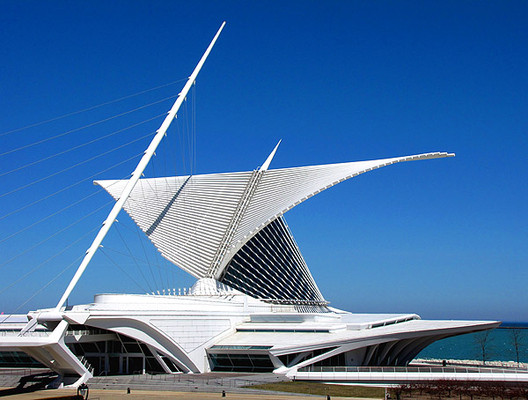
Starting his own practice in Zurich in 1981, Calatrava soon won a competition to design a local train station. The design, inspired by the skeleton of a dog that he had received as a gift, would be an indication of the style that would later define him, with curving concrete corridors that come together to create the semblance of a ribcage. His first American project, the Milwaukee Art Museum, went even further, featuring moving parts that required off-site fabrication, with organic forms reminiscent of a bird. It was also during his early career that would design many of the bridges that helped to define his reputation as an architect, including his Bac de Roda Bridge in Barcelona, Spain.

In the wake of 9/11, Calatrava received the commission in 2003 for the redesigned PATH Rail Terminal at the World Trade Center. However his design, evocative of a phoenix rising from its ashes, became the start in a series of recent controversies, as his project was delayed several times and went violently over budget. This pattern would be repeated in a number of projects including his cancelled Fordham Spire in Chicago and his removal from the commission of the Cathedral of Christ the Light in Oakland, California. However Calatrava has disputed the poor reputation he has collected in recent years, and he nonetheless remains one of architecture’s most influential figures – his ambition and structural ingenuity pushing the envelope with new projects like the Museum of Tomorrow in Rio de Janeiro and the Yuan Ze University Project in Taiwan.

See all of Santiago Calatrava’s Works featured on ArchDaily via the thumbnails below, and more coverage below that:

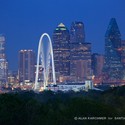


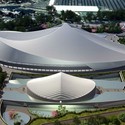
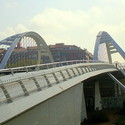
AD Interviews: Santiago Calatrava
Rising from Tragedy: A Conversation with Calatrava, Childs, and Libeskind by Andrew Caruso
Video: Santiago Calatrava On His Design For Ground Zero’s Only Non-Secular Building
Santiago Calatrava’s City of Arts and Sciences Stars in Disney’s “Tomorrowland”
AIA 2012: Architects of Healing
VIDEO: Elegance in Motion at Calatrava’s Liège-Guillemins Railway Station in Belgium
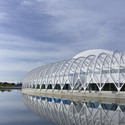
Santiago Calatrava’s Florida Polytechnic Building Awarded “Best in Steel Construction” by AISC
How Santiago Calatrava blurred the lines between architecture and engineering to make buildings move
Construction Well Underway on Santiago Calatrava’s Museum of Tomorrow in Rio de Janeiro
Source:: http://feedproxy.google.com/~r/ArchDaily/~3/T5IMzUvbVI4/spotlight-santiago-calatrava