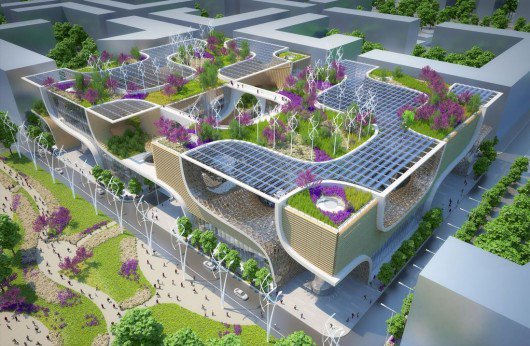

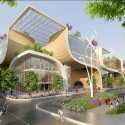
Vincent Callebaut Architectures have received honorary mention for their “Wooden Orchids” proposal in the International Union of Architects‘ (UIA) Mount Lu Estate of World Architecture Competition. Based in Ruichang, China, the competition tasked participants with designing several cultural and commercial complexes near one of the world’s largest flower theme parks. Wooden Orchids consolidates these functions in a green shopping hub that speaks to the area’s demographic and climatic influences.
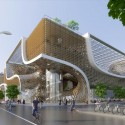
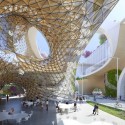
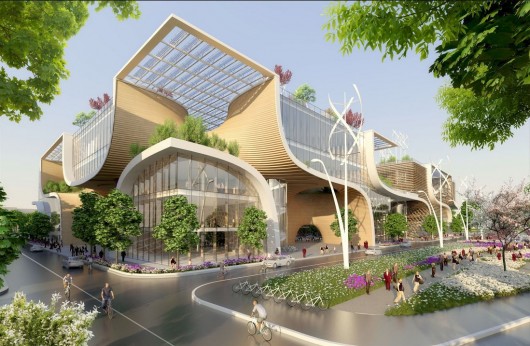
Integrated into the existing urban framework, Wooden Orchids aims to counter the negative effects of the growing influx of rural occupants – namely overcrowding and pollution – while accommodating fluctuating tourism cycles. The plan accomplishes this through interwoven public and private spaces that encourage eco-responsibility from the individual to the community level, all contained within an energy-conscious inhabitable “garden.”
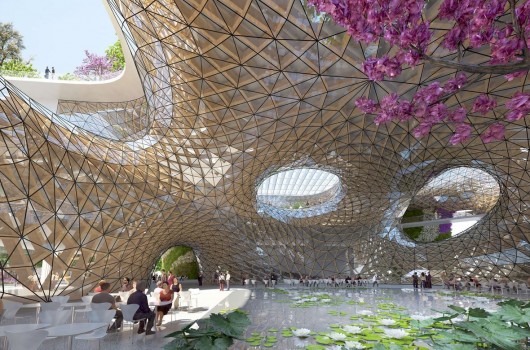
The complex contains material systems that are easily repaired and replaced with the resources at hand, thus decreasing waste, maximizing economic value, and fostering a spirit of re-use. Similarly, the shopping hub’s program is intended for adaptation as flexible multipurpose areas evolve with the variable flow of tourists throughout the year. Additional strides toward eco-responsibility are made through the shops’ digital and organic emphasis, which allows visitors to experience firsthand the development processes of goods while learning about their cradle-to-cradle cycles directly from the manufacturers and farmers.
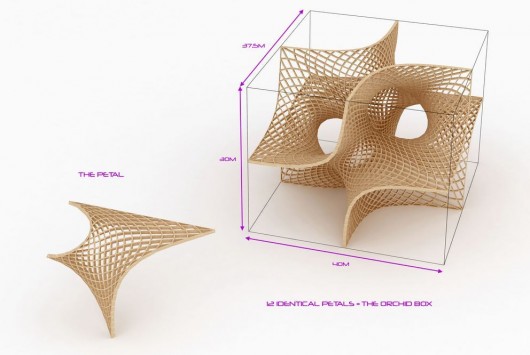
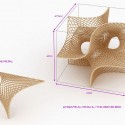
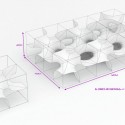
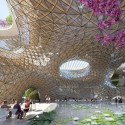
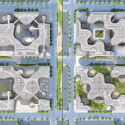
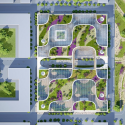
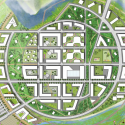
Inspired by numeric sequences found in nature, Wooden Orchids derives its form from the golden section and a biomimetic pattern. The shopping complex uses prefabricated wooden structures to emulate the petals of orchids. The petal module is applied 16 times within the space to compose a complete “orchid box.” In both of the site’s plots, the orchid box is replicated six times, resulting in a collection of 12 cells connected by footbridges.
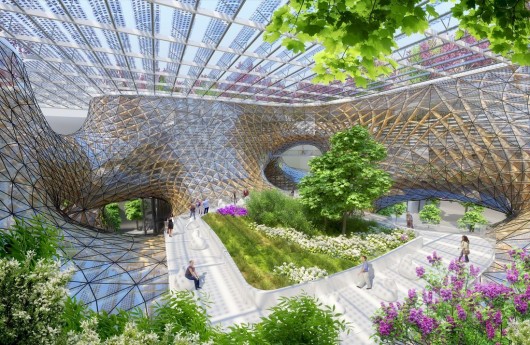
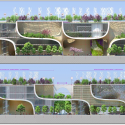
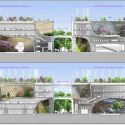
The cells themselves employ additive and subtractive processes in response to their programs. The movie theaters, library, fitness facility, and food service areas rely on solid facades, while the farmers market and shops interlaced with gardens bring in natural light through transparent ones. In addition, each division of the site maintains a unique character enhanced by its own biodiversity and colors, while a network of bicycle and pedestrian paths creates an internal linkage system.
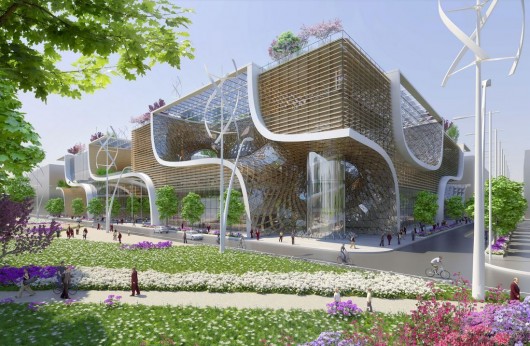
In terms of sustainability, the complex relies heavily on passive strategies and renewable energy sources to achieve a 70% reduction in energy use. These include geothermal heating and cooling, rainwater collection, maximized daylighting through building orientation, wind turbines, and communal rooftop orchards that purify the air.
Click here to view the embedded video.
Competition: Molewa, Mount Lu Estate of World Architecture, Ruichang, China
Award: Honorary Mention
Project Name: WOODEN ORCHIDS
Architects: Vincent Callebaut Architectures
Location: MOLEWA, Ruichang, Jiujiang, Jiangxi, China
Project Manager: Creativersal International, Ltd., Hong Kong
Technical Advisor: Chetwoods Architects, London
Project Promoter: Huayan Cultural Investment Company, Ltd., Beijing, China
Area: 30000.0 sqm
Photographs: Courtesy of Vincent Callebaut Architectures

Vincent Callebaut Proposes “Wooden Orchids” Green Shopping Center for China originally appeared on ArchDaily, the most visited architecture website on 27 May 2015.
send to Twitter | Share on Facebook | What do you think about this?
Source:: http://feedproxy.google.com/~r/ArchDaily/~3/IQ0GzAcAL_Y/